

AWL Gallery Announcing Participation in Abu Dhabi Art Fair
Excavations of the Moment:
Sara Alahbabi, Talin Hazbar, and Enric Ansesa
Press Information November 4, 2025
AWL Gallery Announcing Participation in Abu Dhabi Art Fair
Excavations of the Moment: Sara Alahbabi, Talin Hazbar, and Enric Ansesa
AWL Gallery has the pleasure of announcing its inaugural participation in the Abu Dhabi Art Fair with the exhibition ‘Excavations of the Moment’ featuring Emirati artist Sara Alahbabi, Sharjah-based Syrian artist Talin Hazbar, and Catalan artist Enric Ansesa. The exhibition treats excavation as a way of recognizing memory not just as something we recall, but as something that shapes the spaces we live in. Through its participation in the Abu Dhabi Art Fair in collaboration with Abu Dhabi based Cultural Strategist Lateefa Bin Hamoodah, the gallery is confirming its commitment to the Emirati art scene and to providing a stage for Emirati artists in the global art world. AWL, co-founded by Pepe Baena Diví and headquartered in Girona, Spain, is expanding its presence to Abu Dhabi and Los Angeles. Amongst its artists are Enric Ansesa, Annalee Davis and Agnes Questionmark with Emirati artists Sara Alahbabi and Aisha Alhammadi recently joining its roster.
“Art is a universal language, but for me, it’s also an intimate expression of identity and heritage. Participating in Abu Dhabi Art Fair and creating a dialogue between Emirati and Spanish artists is a profound honour. It brings together my roots in Córdoba, Spain — a place shaped by the enduring legacy of Al-Andalus — and my passion for championing emerging voices. This fair offers a powerful platform where cultures intersect, conversations begin, and new artistic journeys take flight. I’m proud to contribute to that exchange.”
— Pepe Baena Diví, Co-founder and Director, AWL Gallery
“True cultural exchange begins when international galleries engage deeply with Emirati artists and the UAE’s creative landscape. Abu Dhabi Art Fair offers the perfect space for these connections to grow — I’m proud to be facilitating some of that dialogue across borders.”
— Lateefa Bin Hamoodah, Cultural Strategist
Abu Dhabi Art Fair: November 19-23, 2025.
ABU DHABI ART FAIR 2025
Booth Number: AT11
Date: Tuesday 18 2025 (Patrons & Collector Opening),
Wednesday 19 – Sunday 23 November 2025 (Open to Public)
Location: Manarat Al Saadiyat, Abu Dhabi
Press images.
Press Release as PDF.
Download press images and credits below. Please note that the images are free to use strictly when writing about the AWL Gallery and its artists.
Excavations of the Moment
We often think of excavations as uncovering the past or reaching toward distant futures. But in this exhibition, excavation becomes a way of paying close attention to the present. To excavate is to pause, to notice what lies beneath the surface of everyday life. It’s an act of revealing—fragile and strong, hidden and familiar. It’s a way of recognizing memory not just as something we recall, but as something that shapes the spaces we live in.
The works in this exhibition explore how land, silence, memory, and form influence how we exist in the world. Rather than imagining what doesn’t yet exist, these artists focus on what is already here. They invite us to slow down and connect more deeply with the materials and traces that surround us—things that are both fleeting and enduring.
The practices of Sara Alahbabi, Talin Hazbar, and Enric Ansesa come together within this idea of excavation.
Sara Alahbabi draws on the architectural memory of her hometown of Abu Dhabi through sculptural forms that feel both ancient and alive. In her new series of sculptures, Alahbabi explores what it means to engage with minimalism as a woman artist, challenging the purity and austerity often associated with the form. Her works refuse stillness. They animate the spaces they occupy, inviting contemplation while holding tension and quiet humor. Through repetition and variation, she navigates a language of spatial intimacy and subtle distortion, excavating the material memory of the city’s façades and reshaping them through her own artistic lens.
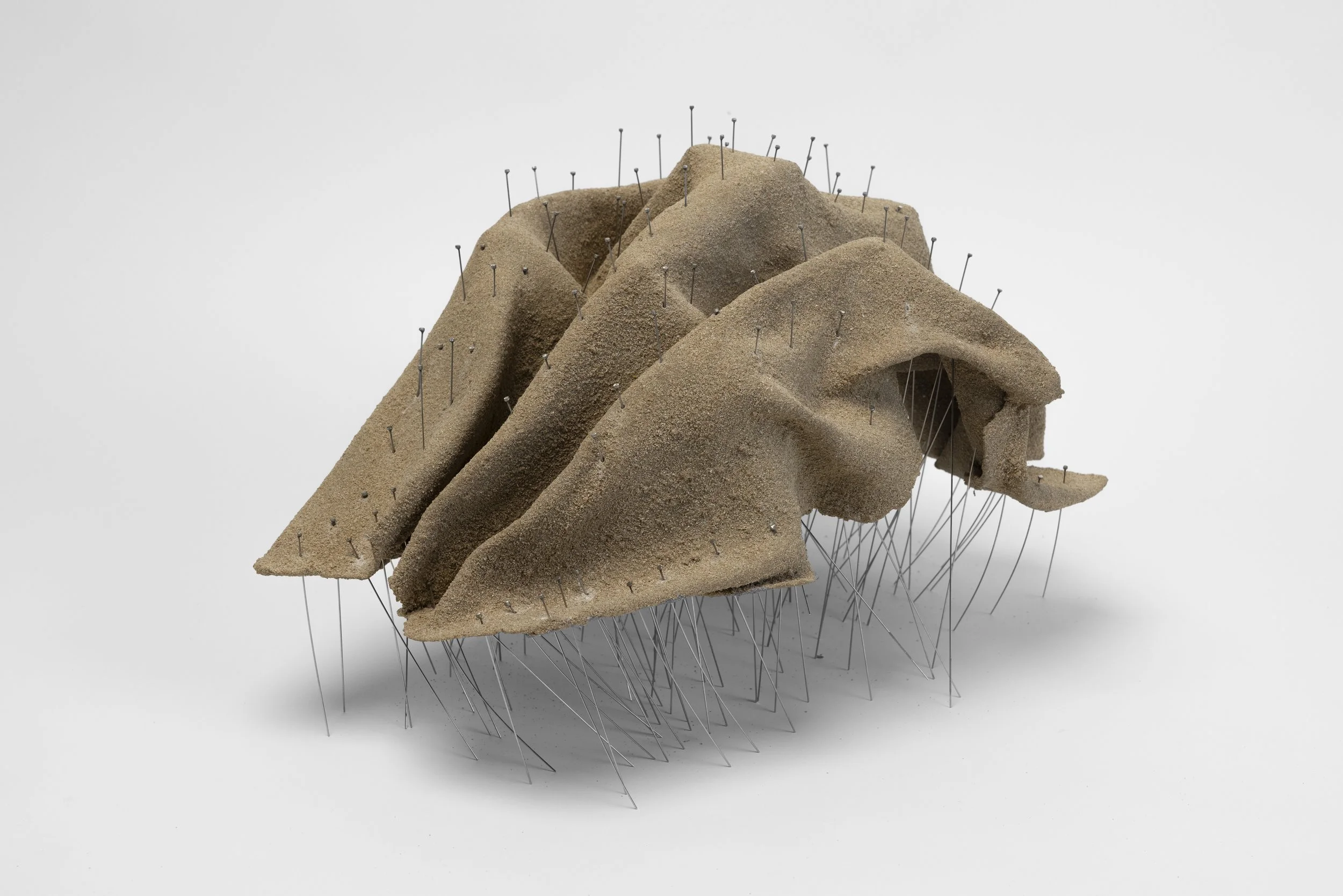
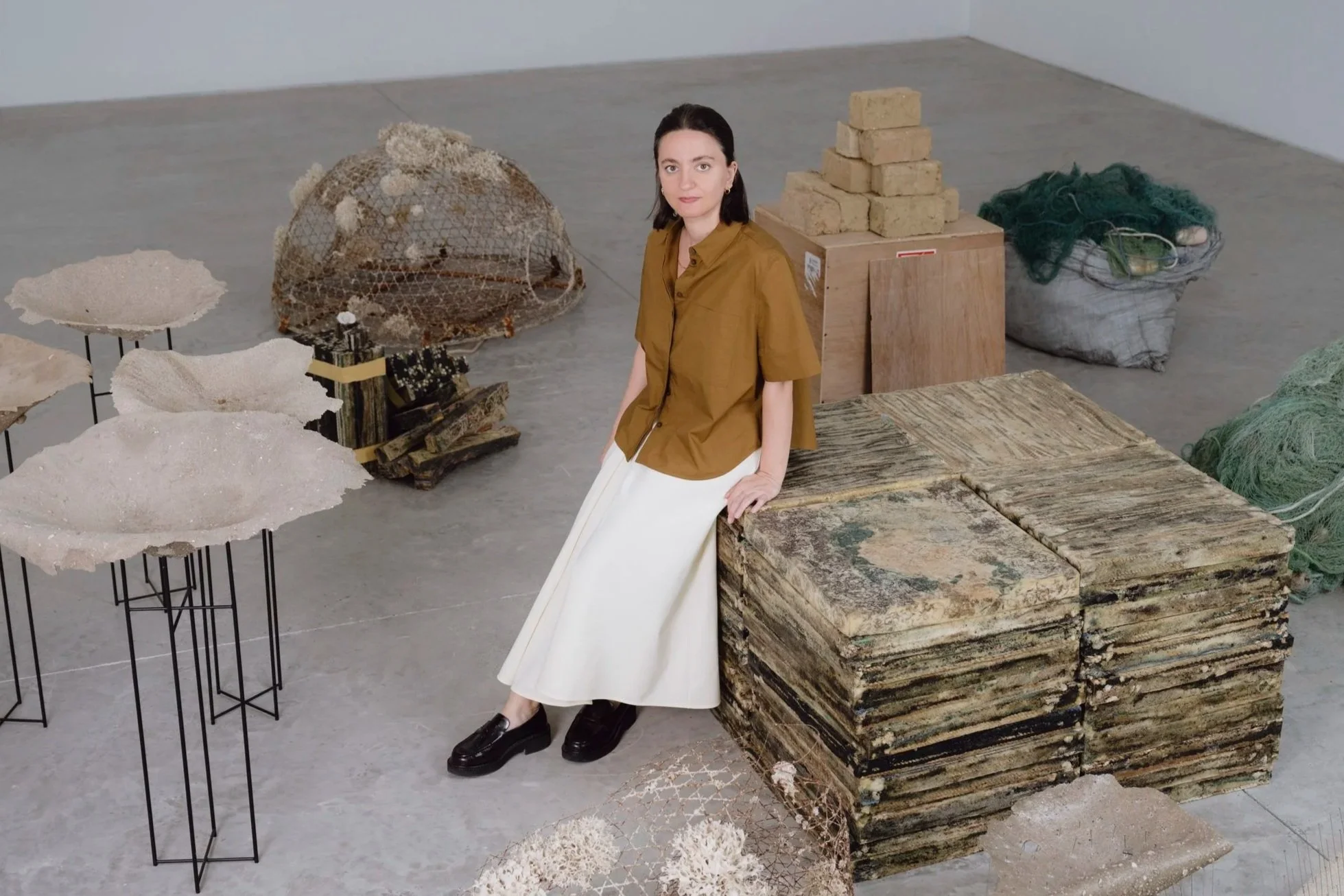
Talin Hazbar works with natural materials like coral, clay, and stone—elements that resist being pinned to a single moment. Her delicate installations feel like landscapes suspended between collapse and renewal, treating the earth as a living, breathing body. Her practice turns to cycles of erosion, sedimentation, and repair, insisting on intimacy with the now rather than speculating on distant futures. Hazbar's forms hold the marks of time and pressure, yet remain open to transformation. They embody both fragility and resilience, inviting the viewer into a space of quiet reflection. Through this sensitivity to material and temporality, she offers a vision of excavation that is tactile, bodily, and grounded.
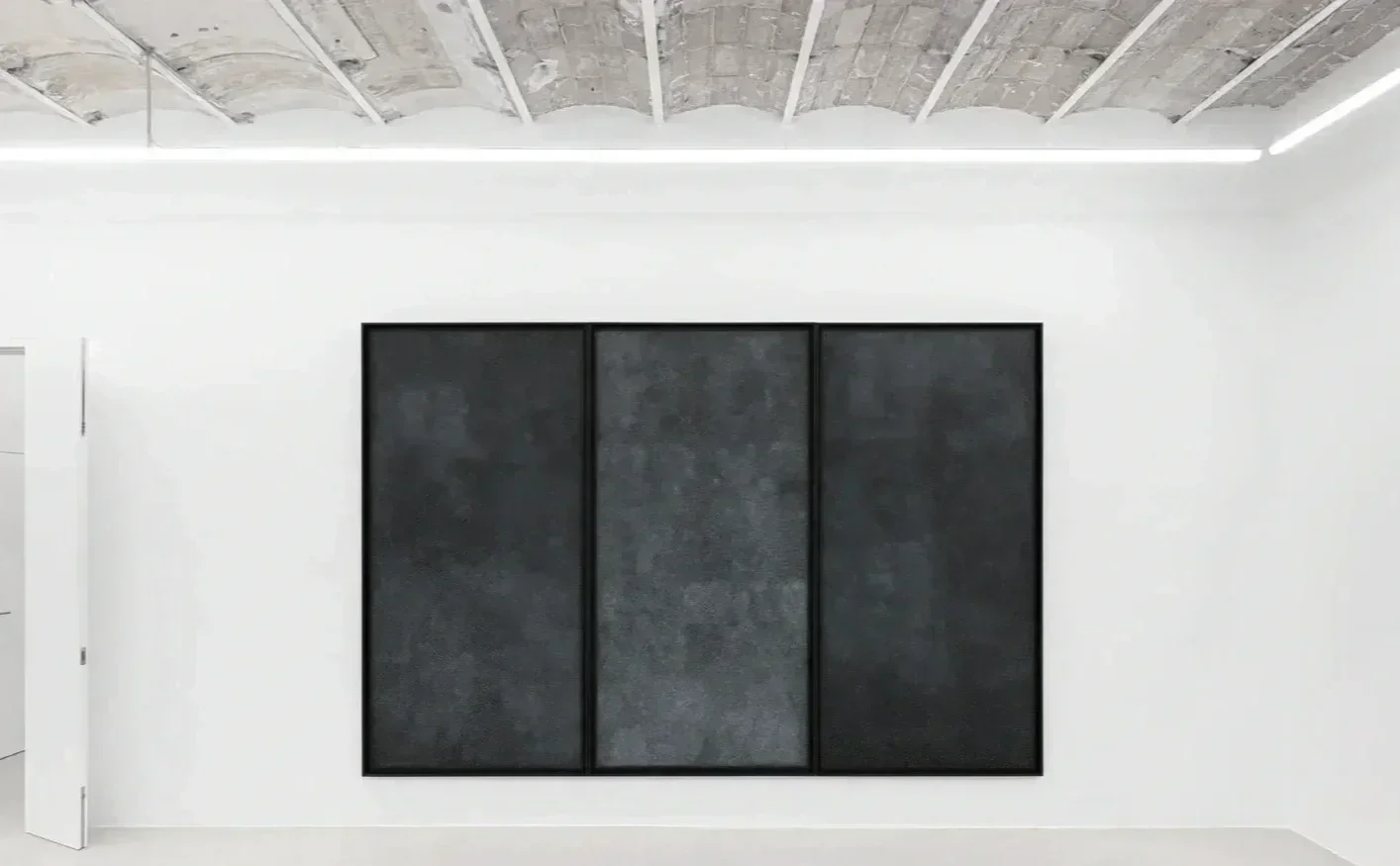
Enric Ansesa approaches excavation through the disciplined and lifelong study of black—not as emptiness, but as a concentrated field of presence. His abstract works, shaped by silence, repetition, and fracture, are rooted in the Catalan post-dictatorship context, where abstraction became both an aesthetic choice and a coded language of resistance. For Ansesa, black is not symbolic but essential. It clears away noise and creates a space for deep attention. His practice treats silence as density and fracture as memory—visible marks that acknowledge rupture and resist forgetting.
Rather than narrating, his work offers a space to remain with what already exists. In the tension between visibility and disappearance, his surfaces speak through absence, inviting viewers to listen to what remains unsaid. Excavation, for Ansesa, is not an act of discovery but of presence. It is about inhabiting the moment fully, and in doing so, keeping memory alive.
Together, these artists offer excavation as a way of seeing — an attentive and thoughtful approach to uncovering what already exists. Rather than seeking spectacle, they create quiet moments of transformation, where absence becomes form and vulnerability opens a path to renewal. On these shifting grounds, the future is not a distant promise — it begins here, in the momentarily monumental traces that surround us: fleeting yet enduring.
Curatorial text by Metha Naser Alsaeedi

Sara Alahbabi, Wind’s Eye: Characters Archive عين الريح: أرشيف الوجوه, 2025. Mixed media sculpture, 45 x 54 x 14 cm, SA25003. All rights reserved by the artist. Photo: Ismail Noor at Seeing Things.

Sara Alahbabi, Wind’s Eye: Characters Archive عين الريح: أرشيف الوجوه, 2025 Mixed media sculpture, 60 x 15 x 15 cm, SA25005. All rights reserved by the artist. Photo: Ismail Noor at Seeing Things

.Sara Dhafer Alahbabi portrait and works. Photo credit: Kristina Sergeeva of Seeing Things.

Sara Alahbabi, Wind’s Eye: Characters Archive عين الريح: أرشيف الوجوه, 2025. Mixed media sculpture, 50 x 21 x14 cm, SA25003. All rights reserved by the artist. Photo: Ismail Noor at Seeing Things.

Sara Dhafer Alahbabi portrait. Photo credit: Kristina Sergeeva of Seeing Things.


Biography – Sara Alahbabi
Sara Dhafer Alahbabi (b. 1990s) is an Emirati conceptual artist whose practice reimagines the architectures of everyday life as poetic encounters. She works across sculpture, installation, photography, and sound, using urban forms as starting points to reflect on visibility, access, and belonging.
Alahbabi holds an MFA in Art and Media (2024) and a BA in Visual Arts and Political Science (2016) from New York University Abu Dhabi. Alongside her practice, she serves as a Senior Interpretation Specialist at the Department of Culture and Tourism – Abu Dhabi, working in education, interpretation, and public engagement. Her work has been presented in solo and group exhibitions including Wrapped Around Me (NYUAD, 2014), Here’s What They Think of Me (NYUAD, 2016), Portrait of a Nation (me Collectors Room, Berlin, 2017), Community & Critique (Warehouse421, 2017), It Comes in Many Forms (RISD Museum, 2020–2021), Bound (Bayt Al Mamzar, 2023), Learning to Unlearn (NYUAD, 2023), and Time Line Electricals: On A Timeline (421 Arts Campus, 2024).

Sara Dhafer Alahbabi portrait. Photo credit: Kristina Sergeeva of Seeing Things.

Sara Alahbabi, Wind’s Eye: Characters Archive عين الريح: أرشيف الوجوه, 2025. Mixed media sculpture, 50 x 21 x14 cm, SA25003. All rights reserved by the artist. Photo: Ismail Noor at Seeing Things
“As an Emirati artist, being represented globally means inviting the world to engage with our unique narratives.
It’s a chance to let our creative vision spark meaningful conversations across cultures.”— Sara Alahbabi

Enric Ansesa, The Crosses Memory, 1997. Mixed media on canvas 27 x 35 cm. Courtesy of AWL and Enric Ansesa

Modern portrait of Enric Ansesa. Courtesy of AWL and Enric Ansesa

Enric Ansesa, Escrits entre la nit i l alba X, 1982. Mixed media on canvas. Work: 130 x 162 cm. Courtesy of AWL and Enric Ansesa

Vintage portrait of Enric Ansesa. Courtesy of AWL and Enric Ansesa

Enric Ansesa, Letter, 1999. Acrylic on canvas 27 x 35 cm. Courtesy of AWL and Enric Ansesa
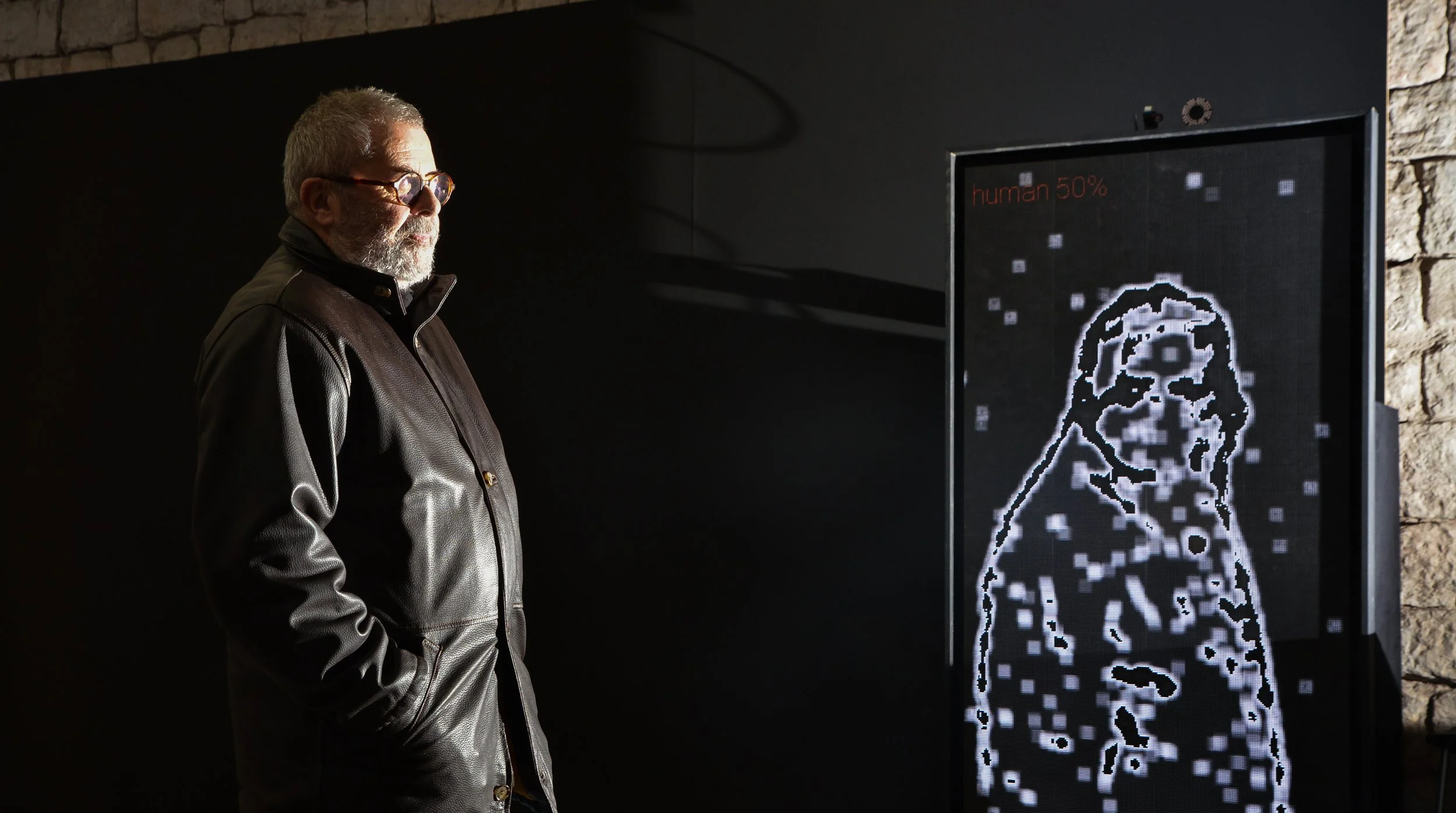


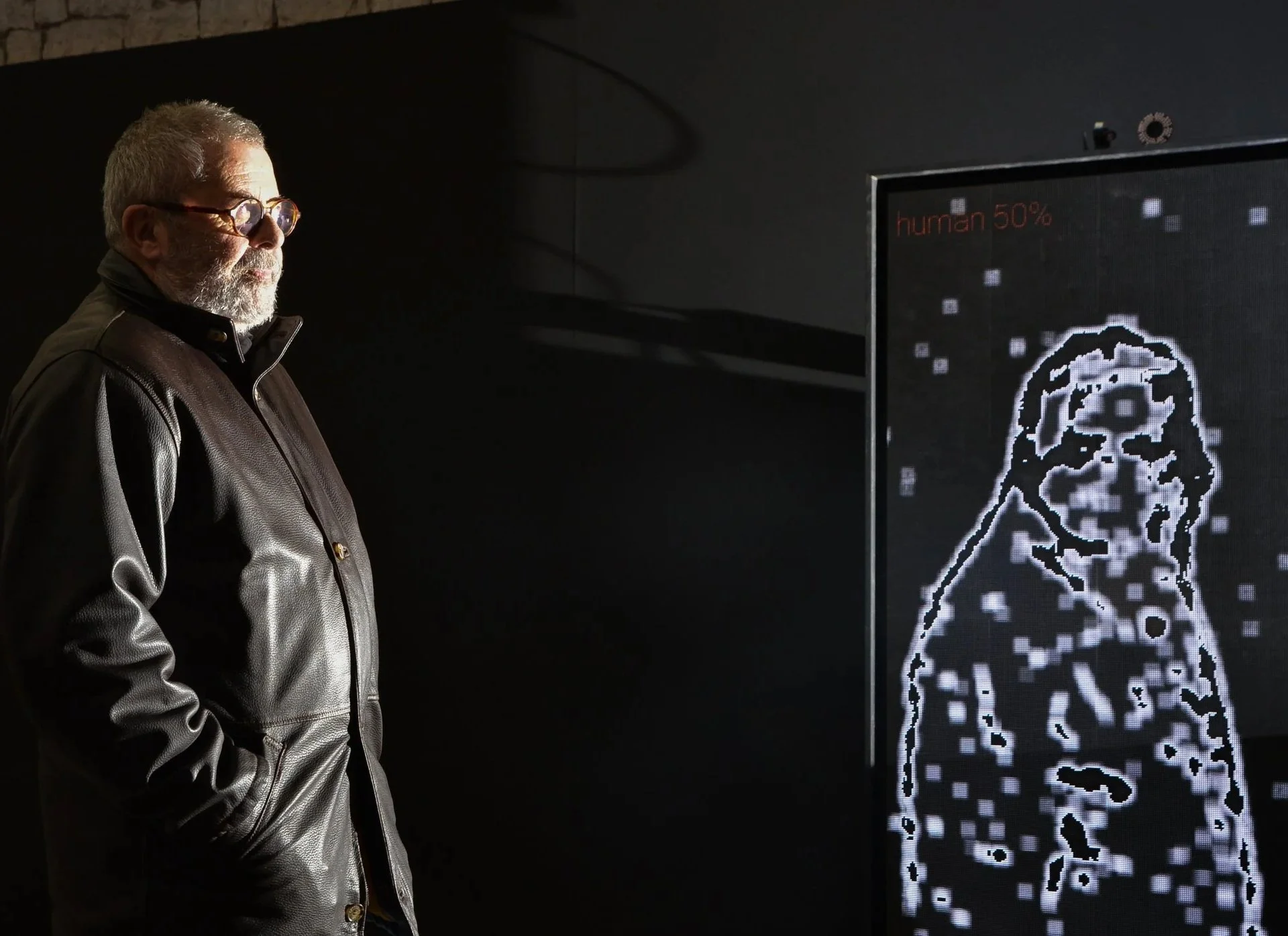
Modern portrait of Enric Ansesa. Courtesy of AWL and Enric Ansesa
Biography – Enric Ansesa
Enric Ansesa (b. 1945, Girona, Spain) is a Girona-based visual artist and master colorist whose six-decade practice is grounded in a rigorous exploration of black as both material and metaphysical presence. Working through painting, drawing, and installation, he has developed a visual language in which black is a generative field that holds tension between presence and disappearance, memory and silence, resistance and transcendence.
His practice emerged in the cultural and political atmosphere of post-Franco Catalonia. As a founding member of the Assemblea Democràtica d’Artistes de Girona in the 1970s, he played a role in reasserting freedom of expression through abstraction. One of the pivotal moments in his early career was the commission to redesign the façades of the iconic houses along the Onyar River in Girona. Commissioned by the newly restored Generalitat de Catalunya, the work used vibrant color as a symbol of democratic renewal after dictatorship. This public intervention marked his last engagement with color. Since 1983, black has been the exclusive focus of his visual and philosophical inquiry.
Over the decades, Ansesa’s work has expanded to engage themes of memory, rupture, perception, and spiritual interiority. Series such as Sutures and Black-on-Black explore thresholds, gestures of repair, and the role of silence as a structuring force. His use of layered mark-making, reflective surfaces, and architectural forms creates quiet spaces for contemplation. Works from the ‘Labyrinth of Islam’ introduce sacred geometry and temporal depth, aligning his abstraction with spiritual traditions of repetition and stillness.
Ansesa continues to work from his studio in Girona, maintaining a practice that is both rooted and far-reaching. His work has been exhibited widely in Spain, Italy, and the United States and is represented in major collections including the Museu d’Art de Girona, the Vila Casas Foundation, and Princeton University Museum. His contributions to the cultural identity of Girona are both public and philosophical, offering a lasting vision of abstraction as a space of presence, resistance, and renewal.
Enric Ansesa, The Crosses Memory, 1997. Mixed media on canvas 27 x 35 cm. Courtesy of AWL and Enric Ansesa

Talin Hazbar, Surrender, 2025. Sand, adhesive, pins, 55 x 55 x 30 cm. TH25002. All rights reserved by the artist. Photo: Ismail Noor at Seeing Things

Talin Hazbar portrait. Photo credit: Kristina Sergeeva of Seeing Things.

Talin Hazbar Syria, b. 1988, Scrunch, 2025, Sand, fiberglass, pins, 60 x 50 x 30 cm, TH25003. All rights reserved by the artist. Photo: Ismail Noor at Seeing Things

Talin Hazbar Syria, b. 1988, Scrunch, Detail. 2025, Sand, fiberglass, pins, 60 x 50 x 30 cm, TH25003. All rights reserved by the artist. Photo: Ismail Noor at Seeing Things

Talin Hazbar, Surrender, Detail. 2025. Sand, adhesive, pins, 55 x 55 x 30 cm. TH25002. All rights reserved by the artist. Photo: Ismail Noor at Seeing Things


Biography – Talin Hazbar
Talin Hazbar (b. 1988, Syria) is a visual artist and architect based in the United Arab Emirates. Her practice investigates natural materials as vessels of memory and transformation, moving between fragility and resilience, disappearance and re-emergence. Working with sand, coral, clay, and stone, she draws out narratives where geological time and cultural history converge, revealing how matter itself carries the traces of both endurance and change.
Hazbar views art as an act of excavation and care. In her practice, material becomes both witness and mediator, preserving the memory of time while opening new possibilities for continuity and transformation. Trained in architecture, Hazbar has developed a transdisciplinary approach that bridges design, ecology, and material research. She has participated in leading residency programs including the Salama bint Hamdan Emerging Artists Fellowship in partnership with the Rhode Island School of Design (2014), the dieDAS Fellowship Program, Farming Materials’ Ecologies, Saaleck, Germany (2020), and the AlUla Residency, Oasis Reborn, Saudi Arabia (2021–2022).
Her work has been exhibited internationally at institutions and biennials such as Art Basel Paris (2024), the Abu Dhabi Music and Arts Foundation (2022), the NGV Architecture Triennial at the National Gallery of Victoria, Melbourne (2020), Louvre Abu Dhabi (2018), Noor Riyadh (2023), the Qatar Museums Biennale Arab Design Now (2024), the Al Shindagha Museum (2019), and Sèvres Gallery, Paris (2019).
Talin Hazbar portrait. Photo credit: Kristina Sergeeva of Seeing Things.
Talin Hazbar, Surrender, Detail. 2025. Sand, adhesive, pins, 55 x 55 x 30 cm. TH25002. Photo: Ismail Noor at Seeing Things
Media contact:
Sofia Bertilsson
Art Insider PR
sofia@artinsiderpr.com
For editors:
About AWL Gallery
Founded in 2024, AWL is headquartered in Girona, with an expanding presence in Abu Dhabi and Los Angeles. The gallery represents emerging and established voices whose transdisciplinary practices explore socio-cultural dynamics, the human experience, and the complexities of diaspora. AWL places strong emphasis on discourse that challenges conceptual boundaries while fostering cross-cultural dialogue across diverse artistic traditions and audiences. With a curatorial approach rooted in social awareness, AWL engages with the global art community through transnational collaboration and experimental initiatives.

Girona, Spain
c/ Sta Eugènia 5, pral 1a
17001 Girona
info@awl.gallery
https://awl.gallery
Abu Dhabi, UAE
Los Angeles, USA
Earlier press releases.
Press Information October, 2025
AWL Gallery Announcing Representation of Emirati Artists
Sara Alahbabi and Aisha Alhammadi join AWL Gallery
AWL Gallery has the pleasure of announcing the representation of two Emirati artists, Sara Alahbabi and Aisha Alhammadi, ahead of its participation in Abu Dhabi Art Fair in November 2025 in collaboration with Abu Dhabi based Cultural Strategist Lateefa Bin Hamoodah. With Alahbabi and Alhammadi joining its roster, the gallery is confirming its commitment to the Emirati art scene and to providing a stage for Emirati artists in the global art world. Headquartered in Girona, Spain, AWL is a contemporary art gallery that is expanding its presence to Abu Dhabi and Los Angeles under the direction of Pepe Baena Diví. Amongst its artists are Enric Ansesa, Annalee Davis and Agnes Questionmark.
“Participating in Abu Dhabi Art and fostering dialogue between Emirati and Spanish artists is a profound honour, bringing together my roots in Córdoba and my commitment to supporting emerging voices.”
— Pepe Baena Diví, Co-founder and Director, AWL Gallery
"True cultural exchange begins when international galleries engage deeply with Emirati artists and the UAE’s creative landscape. Abu Dhabi Art offers the perfect space for these connections to grow — I’m proud to be facilitating some of that dialogue across borders."
— Lateefa Bin Hamoodah, Cultural Strategist
Sara Alahbabi is a conceptual artist whose practice reimagines the architectures of everyday life as poetic encounters. She works across sculpture, installation, photography, and sound, using urban forms as starting points to reflect on visibility, access, and belonging. Alahbabs early work combined walking, mapping, and photographic documentation to trace the subtleties of Abu Dhabi’s urban environments — observing how nocturnal rhythms, informal architectures, and ambient light construct experiences of presence and invisibility. These projects laid the foundation for a practice deeply rooted in embodied research and sensitivity to detail. Over time, Alahbabi expanded this vocabulary into sculptural and material investigations that foreground thresholds, windows, and transitional spaces as metaphors for movement between interior and exterior, presence and absence.
In her current sculpture series, Wind’s Eye: Characters Archive, Alahbabi develops this language further, presenting works that stand both as autonomous objects and as collective arrangements. Matte finishes and vibrant colors disrupt the neutrality of concrete and minimalism, reframing them through playfulness, humor, and humanization. These works explore how abstraction can function as character rather than austerity, inviting audiences to engage with architecture not as static structure but as animated presence.
Aisha Alhammadi's work explores geometry, memory, and material transformation. Working primarily with marble, she creates sculptural works that reflect on silence, repetition, and the spiritual dimensions of form. Her early interest in Islamic geometric systems introduced her to ideas of symmetry and sacred order. Over time, her focus has shifted toward geometry as a more open and evolving language. Rather than using it as decoration, she treats it as a means of inquiry. Her forms are shaped through acts of carving and reduction, where absence becomes a central part of what is being communicated.
Alhammadi’s practice draws on the rhythms of her environment. Architectural forms, domestic spaces, and spatial memories influence the textures and structures that emerge in her work. Through careful attention to material and time, she creates sculptural environments that offer space for contemplation.